
Global Gear Motor Market: Trends, Drivers and Opportunities
Introduction
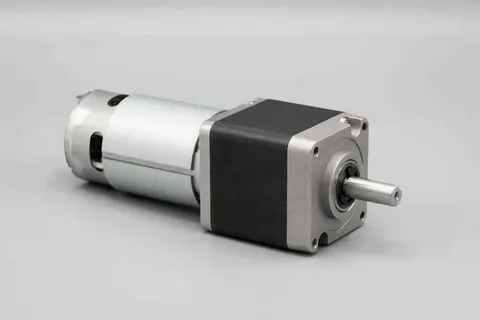
Gear motors combine an electric motor with a gear reduction system (gearbox) to deliver high torque at low speed in a compact package. They are ubiquitous across industries — powering conveyors, packaging machines, conveyors in logistics, HVAC dampers, industrial mixers, robotics, and many automation systems. The gear motor market spans AC and DC motors, a variety of gear types (worm, helical, planetary, bevel), and sizes from fractional-horsepower units for appliances to heavy-duty industrial drives. As manufacturing, automation, and material-handling needs grow, demand for efficient, reliable, and compact gear motors is rising worldwide.
Market dynamics (Drivers, Challenges, Opportunities)
Drivers: Industrial automation and the rise of smart manufacturing are the primary growth engines. Companies are replacing manual and pneumatic systems with electric drives to gain better control, energy savings, and predictive maintenance capabilities. E-commerce and logistics expansion increase demand for conveyors and sortation systems, which rely heavily on gear motors. Urbanization and infrastructure projects also push demand in HVAC, elevators, and pumps. Additionally, improvements in motor efficiencies, stricter energy regulations, and incentives for electrification motivate upgrades to modern gear motor solutions.
Challenges: The market faces headwinds from supply-chain volatility (especially for rare-earth magnets and semiconductor components), price pressure from low-cost manufacturers, and the technical complexity of integrating gear motors into smart systems. Thermal management, noise reduction, and maintenance in harsh environments remain design challenges. For some applications, alternative technologies like direct-drive motors (which eliminate gearboxes) threaten market share where high precision and low maintenance are paramount.
Opportunities: Electrification of mobile equipment, small robotic platforms, and continued rollout of Industry 4.0 offer significant upside. Demand for compact, high-efficiency planetary gear motors and integration-friendly modules (with built-in encoders, brakes, and controllers) is growing. There’s a strong opportunity in retrofit markets — replacing old motors with energy-efficient gear motors — and in sectors pursuing predictive maintenance, where smart sensors and connectivity add value beyond basic torque/speed functions.
Market segmentation
By Motor Type: AC gear motors, DC gear motors (brushed and brushless), and stepper gear motors. AC units dominate heavy industrial use; brushless DC (BLDC) gains traction in precision and variable-speed applications.
By Gear Type: Worm, helical, bevel, planetary, and harmonic. Worm gears are common where compactness and self-locking are required; planetary gears are preferred for high torque density and compact robotics.
By Power Rating: Fractional (under 1 kW), small (1–5 kW), medium (5–50 kW), and large (>50 kW). Fractional and small categories are fastest growing due to light-industrial and automation uses.
By End-Use Industry: Material handling & logistics, food & beverage, packaging, automotive, HVAC, water & wastewater, mining & minerals, robotics & automation, marine & offshore. Material handling, packaging, and HVAC are leading demand segments.
By Region: Asia-Pacific, North America, Europe, Latin America, Middle East & Africa.
Regional analysis
Asia-Pacific leads in volume and continued capacity expansion — China, India, Japan, and South Korea are major producers and consumers. Rapid industrialization, a large manufacturing base, and aggressive automation adoption drive demand. Europe emphasizes high-efficiency gear motors to meet stringent energy standards; Germany and Italy are key markets for premium, engineered solutions. North America sees strong demand from logistics, automated warehouses, and retrofit projects; the U.S. market favors smart, connected gear motor packages. Latin America and Middle East & Africa are emerging markets with growing infrastructure and oil & gas-driven demand, but adoption is uneven and price-sensitive.
Key trends
- Energy efficiency and IE-class compliance: Upgrading motors and gearboxes to meet IE3/IE4 efficiency classes is a major trend, propelled by regulation and operating-cost reduction.
- Smart gear motors: Integration of sensors (temperature, vibration), encoders, and communication protocols (Ethernet/IP, Modbus, CAN) for predictive maintenance and asset tracking.
- Compact high-torque designs: Planetary and helical-planetary systems optimized for robotics and compact conveyors.
- Modular drive packages: Pre-integrated gear motor + inverter + controller units that simplify OEM integration and reduce installation time.
- Materials & noise reduction: Use of composite housings and improved lubrication to lower weight, noise, and maintenance intervals.
- Local manufacturing & aftermarket: Growth of localized service centers and remanufacturing/repair networks to shorten lead times and support field servicing.
Future outlook
The gear motor market is set for steady growth over the next 5–10 years driven by automation, logistics expansion, and energy-efficiency retrofits. While direct-drive and integrated servo solutions will capture some high-precision niches, the versatility and cost-efficiency of gear motors will secure their long-term relevance. Vendors that offer smart, modular, and energy-efficient solutions with strong aftermarket support will gain market share. Expect increased consolidation among component suppliers and more partnerships between motor manufacturers and automation platform providers. Growth will be strongest in Asia-Pacific and North America for volume and value respectively, while Europe will lead on premium, high-efficiency systems.
Conclusion
Gear motors remain a foundational motion-control solution across industries. Their blend of torque multiplication, compactness, and adaptability makes them ideal for a broad spectrum of applications from conveyors to robotics. The market’s future is shaped by energy regulation, digitalization, and evolving application demands — vendors who innovate on efficiency, connectivity, and service will lead the next phase of growth.

 English
 French
 Spanish
 Portuguese
 Deutsch
 Turkish
 Dutch
Dutch
 Italiano
 Russian
 Romaian
 Portuguese (Brazil)
 Greek
Greek