
Global Lung Cancer Therapy Market: Navigating the Path to 2030
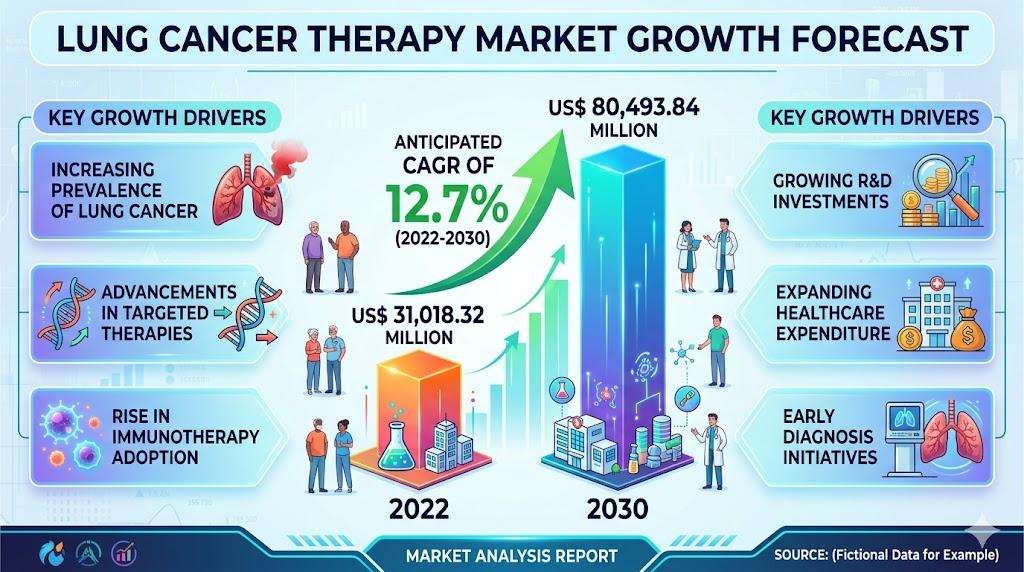
The global landscape for oncology is undergoing a radical shift, with the lung cancer therapy market standing at the forefront of medical innovation. As one of the most prevalent and fatal forms of cancer worldwide, the demand for advanced, effective, and personalized treatment modalities has never been higher. According to recent industry analysis by The Insight Partners, the lung cancer therapy market is expected to grow from US$ 31,018.32 million in 2022 to US$ 80,493.84 million by 2030. This expansion represents a robust CAGR of 12.7% during the forecast period from 2022 to 2030.
This growth is not merely a reflection of increasing patient numbers but is also driven by a fundamental evolution in how the disease is managed. The transition from traditional, broad-spectrum chemotherapy to highly specific targeted therapies and immunotherapies is redefining survival rates and patient quality of life. As healthcare systems globally prioritize early detection and precision medicine, the market is poised for a decade of unprecedented technological and clinical breakthroughs.
Key Market Drivers Fueling Growth
The trajectory of the lung cancer therapy market is influenced by several multifaceted drivers that span clinical, demographic, and technological domains.
1. Rising Global Incidence and Prevalence
The primary driver remains the increasing incidence of lung cancer globally. While smoking and tobacco consumption remain the leading causes with significant regular smoking rates still observed in countries like Germany and the UK—environmental factors are playing an increasingly large role. Air pollution, occupational exposure to carcinogens (such as asbestos and diesel exhaust), and an aging global population contribute to the rising tide of new diagnoses. In the United States alone, estimates suggest over 238,000 new cases annually, necessitating a scaled-up therapeutic infrastructure.
2. Advancements in Precision Medicine and Biomarkers
The market is shifting from a "one-size-fits-all" approach to a biomarker-driven model. Precision medicine allows clinicians to tailor treatments based on the genetic profile of a patient’s tumor. The identification of oncogenic drivers such as EGFR, ALK, ROS1, and KRAS mutations has led to the development of targeted therapies that offer higher efficacy and fewer side effects than traditional cytotoxic drugs. This "targeted" approach is currently the dominant segment in the market, as it significantly improves progression-free survival in patients with Non-Small Cell Lung Cancer (NSCLC).
Download Sample PDF : https://www.theinsightpartners.com/sample/TIPRE00030093
3. Breakthroughs in Immunotherapy
Immunotherapy, particularly immune checkpoint inhibitors (ICIs), has revolutionized the standard of care. By leveraging the body’s own immune system to recognize and attack cancer cells, drugs like Pembrolizumab (Keytruda) and Nivolumab (Opdivo) have become blockbusters. The expansion of these therapies into first-line treatment settings and their use in combination with chemotherapy are major growth catalysts.
4. Integration of Minimally Invasive Procedures
While noninvasive therapies like radiation and chemotherapy hold the largest market share, the minimally invasive segment is projected to grow at a higher CAGR through 2030. Techniques such as radiofrequency ablation, microwave ablation, and cryoablation are becoming more common for patients who are not candidates for major surgery, offering shorter recovery times and reduced hospital stays.
Top Players in the Global Market
The competitive landscape is dominated by pharmaceutical giants who are investing heavily in R&D and strategic collaborations to maintain their market position. Leading companies include:
-
F. Hoffmann-La Roche Ltd (Genentech)
-
AstraZeneca
-
Merck & Co., Inc.
-
Bristol-Myers Squibb Company
-
Pfizer Inc.
-
Eli Lilly and Company
-
Novartis AG
-
Sanofi
-
Boehringer Ingelheim International GmbH
-
Takeda Pharmaceutical Company Limited
These players are focusing on "next-generation" molecules, including antibody-drug conjugates (ADCs) and bispecific antibodies, which represent the next frontier in lung cancer treatment.
Regional Outlook: North America and Asia-Pacific
North America currently holds the largest share of the global market, supported by a sophisticated healthcare infrastructure, high awareness regarding early screening, and rapid adoption of newly approved drugs. However, the Asia-Pacific region is expected to register the highest CAGR through 2030. This growth is driven by expanding healthcare access in China and India, rising disposable incomes, and government initiatives aimed at reducing the cancer burden in these densely populated nations.
Future Outlook to 2030
By 2030, the lung cancer therapy market will likely be characterized by the seamless integration of AI-powered diagnostics and liquid biopsies. These technologies will allow for real-time monitoring of tumor mutations, enabling "dynamic" treatment plans that evolve as the cancer changes. As the market approaches the US$ 80 billion mark, the focus will remain steadfast on turning lung cancer from a terminal diagnosis into a manageable chronic condition through continuous innovation.
Trending Reports :
Portable Diagnostic Devices Market
Bioresorbable Medical Material Market
About Us -
The Insight Partners provides comprehensive syndicated and tailored market research services in the healthcare, technology, and industrial domains. Renowned for delivering strategic intelligence and practical insights, the firm empowers businesses to remain competitive in ever-evolving global markets.
Contact Information -
Email: sales@theinsightpartners.com
Phone: +1-646-491-9876
Also Available in : Korean| German| Japanese| French| Chinese| Italian| Spanish

 English
 Arabic
 French
 Spanish
 Portuguese
 Deutsch
 Turkish
 Dutch
Dutch
 Italiano
 Russian
 Portuguese (Brazil)
 Greek
Greek